
Olympiad Exams vs School Exams: Key Differences
Olympiad Exams vs School Exams: What Is the Difference?
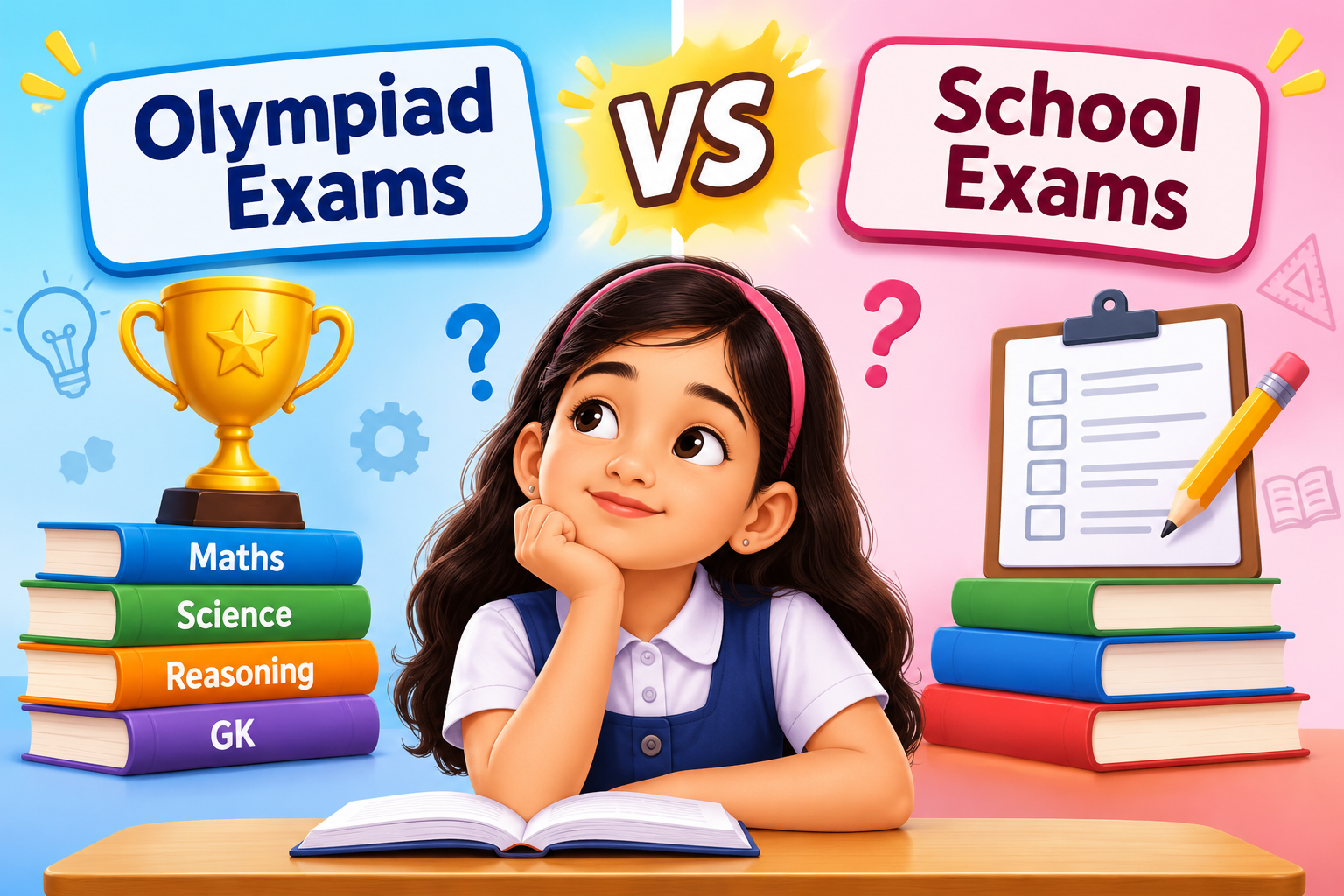
Students participate in a variety of examinations throughout their educational journey. While school assessments help teachers evaluate classroom learning, Olympiads encourage students to apply their understanding, think logically, and solve challenging problems. Understanding the distinction between these two formats helps students and parents choose the right learning strategy.
For students exploring the World Olympiad Foundation and other academic competitions, it is essential to recognize how these assessments differ in purpose, question styles, preparation strategies, and learning outcomes.
Although both exam types support academic development, they are designed to achieve different educational goals. This guide explains their main differences, benefits, and preparation approaches in clear, simple terms.
What Are School Exams?
School exams are assessments conducted by educational institutions to evaluate how well students understand the topics taught in their classrooms. These tests follow the school's prescribed curriculum and grade-level syllabus.
Students typically take periodic tests, unit assessments, half-yearly examinations, and annual exams. Their results help teachers monitor academic progress and identify subjects that require additional support.
Generally, school assessments evaluate subject knowledge—including definitions, formulas, and standard methods taught during the academic year. For example, a science exam might ask students to explain the water cycle or label a diagram, while a mathematics exam focuses on calculations and formulas taught in class. The primary goal is to determine whether students have achieved the expected learning outcomes for their grade.
What Are Olympiad Exams?
Olympiad examinations are competitive academic assessments designed to inspire deeper conceptual understanding, logical reasoning, analytical thinking, and practical application of knowledge.
Depending on the subject, students encounter multiple-choice questions, reasoning-based puzzles, application-oriented tasks, or problems that require spotting patterns and connecting multiple concepts. Unlike a conventional classroom test, an Olympiad often presents a familiar concept in an unexpected context—requiring students to grasp the underlying principle before arriving at a solution.
These competitions span subjects such as Mathematics, Science, English, General Knowledge, and Logical Reasoning across WOF Olympiad programs.
Olympiad Exams vs School Exams: Key Differences
Although both examinations help students grow academically, their structure and focus differ significantly:
| Feature | School Exams | Olympiad Exams |
|---|---|---|
| Main Intention | Evaluate classroom learning and curriculum mastery. | Assess conceptual understanding, logic, and real-world application. |
| Syllabus | Follows the prescribed school curriculum. | Follows the Olympiad organizer's grade-wise syllabus. |
| Question Style | Direct questions and standard textbook-based problems. | Reasoning-based, analytical, and application-oriented questions. |
| Difficulty Level | Aligned with standard grade-level learning goals. | Requires deeper reasoning and multi-step problem-solving strategies. |
| Preparation | Textbooks, classroom notes, homework, and revision. | Concept clarity, practice worksheets, sample papers, and logic puzzles. |
| Assessment | Measures performance against school evaluation benchmarks. | Evaluates performance against broader competitive benchmarks. |
| Results | Contributes directly to school grades and promotion. | Provides performance reports, rankings, certificates, and recognition. |
| Learning Focus | Understanding and recalling prescribed lessons. | Applying knowledge, analyzing data, and solving unfamiliar problems. |
Because formats vary between schools and Olympiad organizers, students and parents should always review the official exam guidelines before beginning preparation.
Benefits of School Exams and Olympiad Exams
Both forms of assessment contribute meaningfully to a student's academic growth in complementary ways:
Benefits of School Exams
- Curriculum Mastery: Strengthens understanding of core grade-level lessons taught in class.
- Writing & Presentation Skills: Trains students to structure detailed written answers and manage time.
- Consistent Study Habits: Encourages regular revision and classroom accountability.
- Targeted Teacher Support: Helps educators identify individual strengths and learning gaps early.
Benefits of Olympiad Exams
- Logical Reasoning: Trains students to spot patterns, evaluate clues, and analyze data systematically.
- Conceptual Clarity: Application-based questions promote genuine understanding over rote memorization.
- Problem-Solving Confidence: Breaking multi-step challenges into smaller parts builds self-assurance with unfamiliar tasks.
- Self-Evaluation: Detailed performance insights highlight specific areas that benefit from extra practice.
How to Prepare for Olympiad Exams at Home: A Step-by-Step Guide
Students do not necessarily need external coaching to prepare effectively for an Olympiad. A well-organized home study routine reinforces concepts, sharpens problem-solving, and tracks steady progress:
- Step 1 — Understand Exam Requirements: Review the subject, class level, official syllabus, question format, and exam dates for Classes 1–12.
- Step 2 — Revise School-Level Concepts: Master core school fundamentals first (such as basic arithmetic operations and number patterns) before tackling complex problems.
- Step 3 — Practice Different Question Types: Start with straightforward problems and progress gradually to multi-step reasoning tasks, focusing on why each answer works.
- Step 4 — Follow a Realistic Study Schedule: Dedicate short, consistent blocks—such as 15 minutes of concept revision, 20 minutes of practice questions, and 10 minutes of error review—alongside schoolwork and play.
- Step 5 — Take Timed Practice Tests: Solve sample papers and mock tests to build comfort with exam pacing and decision-making.
- Step 6 — Review Progress Every Week: Maintain a dedicated notebook for tricky questions and key formulas, reviewing mistakes at the end of each week.
How Should Students Balance Both Examinations?
Students do not need to choose between school exams and Olympiads—both fit smoothly into a balanced study plan. The most practical approach is to prioritize regular school lessons while using short weekly practice sessions to build reasoning and application skills.
For example, a student learning fractions for a school test can first complete textbook exercises and then attempt Olympiad-style puzzles involving fraction patterns or real-life applications. When school exams draw near, schedules can temporarily shift toward immediate classroom revision. Alongside academics, students can also nurture creative expression through cultural initiatives like the Chitrakala Utsav.
Conclusion
School exams and Olympiad examinations serve distinct yet complementary purposes. School exams measure mastery of the prescribed classroom curriculum, while Olympiads inspire deeper conceptual learning, analytical reasoning, and independent problem-solving.
With realistic expectations, a steady home study routine, and encouragement from parents, students can excel in both while developing lifelong learning habits. Explore more preparation guides on our blog or contact our team for guidance on upcoming Olympiad opportunities.
Frequently Asked Questions (FAQs)
1. Are Olympiad exams different from school exams?
Yes. School exams primarily evaluate learning based on the prescribed classroom curriculum, whereas Olympiads focus more on logical reasoning, conceptual clarity, and applying knowledge to unfamiliar questions.
2. Can school students participate in Olympiads while studying for school exams?
Yes. Students can balance both by planning their weekly schedule carefully—combining regular school revision with a few short, focused Olympiad practice sessions each week.
3. Are Olympiad exams more difficult than school exams?
The difficulty depends on the subject, grade level, and question format. Olympiads include reasoning-heavy and multi-step application questions, whereas school exams focus on standard grade-level curriculum goals.
4. How can students prepare for Olympiad exams at home?
Students can prepare effectively at home by reviewing the official syllabus, revising school-level concepts, solving varied practice questions, taking timed mock tests, and reviewing mistakes weekly.
5. What is the main purpose of Olympiad examinations?
Their primary purpose is to encourage deeper conceptual understanding, analytical thinking, curiosity, and independent problem-solving skills beyond rote memorization.
6. Do Olympiad results affect school grades?
Usually, Olympiad scores are separate from regular school examination grades. However, recognition policies vary by school, so students should check with their school coordinator or organizer guidelines.